




Read how a month actually closes


How a month gets a name
Under a lender's ask, the useful work is usually the month itself. The heavy word is one of three reports. We say which work we can keep under it.
We work from our office in Dallas. An owner in Amarillo joins by video, with the books open on both screens, and the close still lands on the day we set for both sides of the state.
We close those books with owners in Amarillo so the exceptions are visible before a lender reads them. Steven Palmieri carries the Tax CFO role owners already nicknamed the Entrepreneur's CFO, and the finished books carry that name with yours. We start from the last set you would still hand a banker. We walk through that close with you by video on the day we set.
A month we trust has a start, an end, and a bank balance that agrees. The feed can suggest a category. It cannot decide that a deposit on the second belongs to the month before it. We make that call with you, then we lock the month so the next one starts clean.
Reconciliations are the dull part that saves the year. Every statement line needs a home, including the ones that look like duplicates and the ones that arrived after you thought the month was done. When the last line has a home, the balance sheet stops being a guess.
Owners in Amarillo often feel this at the counter on a Monday, coffee going cold, a statement still folded in a pocket. A month that matches the bank is the relief we hand you, in place of a stack of open weeks.
A lender page can ask for a name this practice will not sign. We say that before the books open, and we say it in one conversation, not after a quarter of soft months. The weekly close keeps the day already on the calendar while that signature question sits unanswered. Pay stays with the company your crew already knows. We sketch the federal return from the locked months, and a blank signature line does not hold that sketch back. A year goes stale when a room full of people stares at a line nobody in this practice can sign.
Call Steven Palmieri about the month itself. A shared inbox never locks a week. When the newest month a bank has agreed with is an old spring, that spring is where the work starts, and the week that just ended waits until the older one is solid.
Read the three words on a report
Audit, review, and compilation in plain words
An audit asks whether the statements are free of a large misstatement, and it asks for evidence beyond the books. A review asks whether anything jumped out as wrong, with less testing. A compilation puts the numbers in statement form and says, in so many words, that nobody tested them.
People shop those three words because a lender, a surety, or a buyer wrote them down. The words are real. The signature on the report is a different job from keeping the books. We keep the books, we set payday up on the provider you choose, and we prepare the return from the closed months. The signed report, when the letter truly needs one, is named on the disclosures page.
If you want the longer plain-English version, it sits on the three report words. The work that is not a report at all sits on the ordinary month.
Read Texas dates around Amarillo
Dates that stay put in Potter and Randall
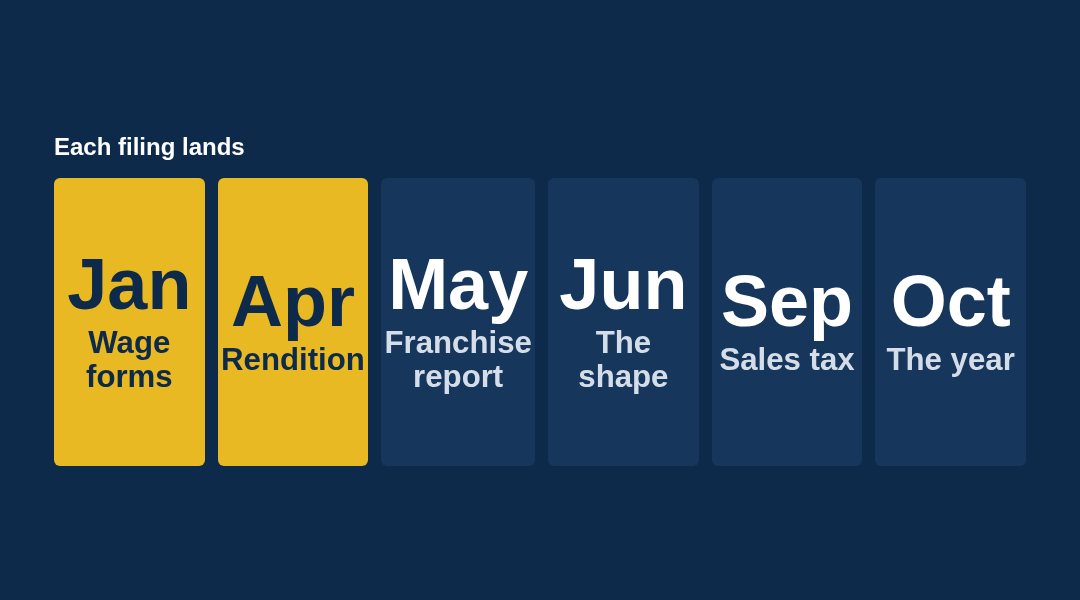
Inside the city the sales-tax rate is 8.25 percent, state plus city, and Potter County and Randall County do not add a county sales tax on top. The return for that tax is generally due on the 20th. A busy fair week does not move the 20th.
Business personal property goes to the county by the middle of April, the 15th, and a written request can slide that same rendition out to the middle of May. The franchise filing follows on that later date, 15 May, for owners in Potter County and Randall County alike. We want both lists printed from books that have already been closed, so nobody is reconstructing a year from memory the night before.
There is no Texas personal income tax. The return we mean, when we say return, is the federal return and the Texas reports that do exist. We talk about them while the year can still change, not in March when the only move left is to file.
Payday is set up here and run by the provider you pick. We do not calculate the checks, we do not move the money, and we do not file as the payday company. If a notice lists documents, we pull those documents out of months that already match the bank. If the state wants a meeting, you are the one who attends it.